

Publications
You can find an updated list of my pubblications in the Astrophysics Data System
Publication summary
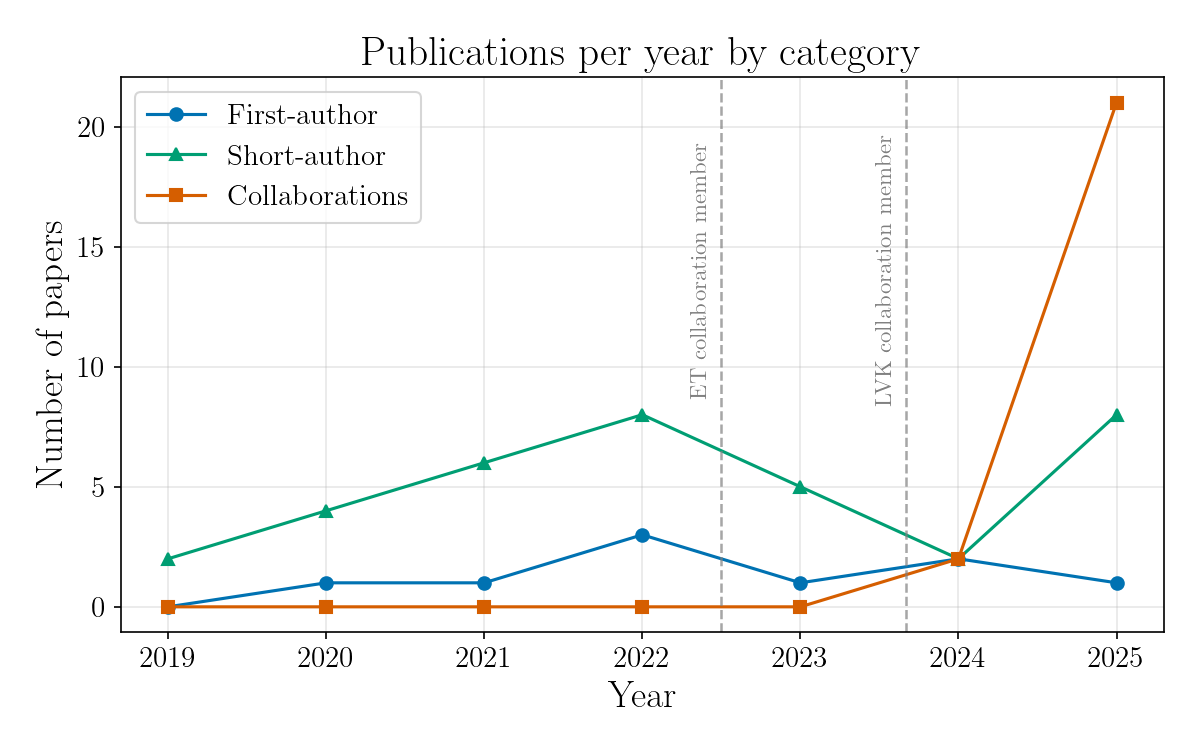
| Total publications | 87 |
| Total publications as first author | 10 |
| Refereed publications | 52 |
| Refereed publications as first author | 7 |
| Total number of citations | 5045 |
| Total number of citations as first author | 413 |
| h-index | 34 |
| h-index as first author | 6 |
Last update: June 8, 2026
2026
GWTC-5.0: An Introduction to Version 5.0 of the Gravitational-Wave Transient Catalog, The LIGO Scientific Collaboration et al., arXiv 05/2026, 2026arXiv260527223T.
GW240925 and GW250207: Astrophysical Calibration of Gravitational-wave Detectors, The LIGO Scientific Collaboration et al., arXiv 05/2026, 2026arXiv260511703T.
Searches for Binary Mergers with Sub-solar Mass Components in Data from the First Part of LIGO–Virgo–KAGRA’s Fourth Observing Run, The LIGO Scientific Collaboration et al., arXiv 05/2026, 2026arXiv260505444T.
Deep Search for Joint Sources of Gravitational Waves and High-energy Neutrinos with IceCube during the Third Observing Run of LIGO and Virgo, Abbasi et al., ApJ 1003(1), 05/2026, 2026ApJ..1003…41A.
Comparing astrophysical models to gravitational-wave data in the observable space, Toubiana et al., PhRvD 113(8), 04/2026, 2026PhRvD.113h3006T.
All-sky search for long-duration gravitational-wave transients in the first part of the fourth LIGO-Virgo-KAGRA observing run, Abac et al., PhRvD 113(8), 04/2026, 2026PhRvD.113h2004A.
Comparing next-generation detector configurations for high-redshift gravitational wave sources with neural posterior estimation, Santoliquido et al., A&A 708 04/2026, 2026A&A…708A.175S.
Narrowband searches for continuous gravitational waves from known pulsars in the first two parts of the fourth LIGO–Virgo–KAGRA observing run, The LIGO Scientific Collaboration et al., arXiv 03/2026, 2026arXiv260325938T.
Searches for Continuous Gravitational Waves from Supernova Remnants in the first part of the LIGO-Virgo-KAGRA Fourth Observing run, The LIGO Scientific Collaboration et al., arXiv 03/2026, 2026arXiv260325808T.
Isolated or Dynamical? Tracing Black Hole Binary Formation through the Population of Gravitational-Wave Sources, Arca Sedda et al., arXiv 03/2026, 2026arXiv260320430A.
Advanced Virgo Plus for O5 – Design Report Overview, Acernese et al., arXiv 03/2026, 2026arXiv260320342A.
GWTC-4.0: Tests of General Relativity. III. Tests of the Remnants, The LIGO Scientific Collaboration et al., arXiv 03/2026, 2026arXiv260319021T.
GWTC-4.0: Tests of General Relativity. II. Parameterized Tests, The LIGO Scientific Collaboration et al., arXiv 03/2026, 2026arXiv260319020T.
GWTC-4.0: Tests of General Relativity. I. Overview and General Tests, The LIGO Scientific Collaboration et al., arXiv 03/2026, 2026arXiv260319019T.
Calibrating spectral siren cosmology with synthetic catalogs of binary black hole mergers, Scarpa et al., arXiv 03/2026, 2026arXiv260315332S.
All-sky Searches for Continuous Gravitational Waves from Isolated Neutron Stars in the Data from the First Part of the Fourth LIGO-Virgo-KAGRA Observing Run, The LIGO Scientific Collaboration et al., arXiv 03/2026, 2026arXiv260314168T.
The Science of the Einstein Telescope, Abac et al., JCAP 2026(3), 03/2026, 2026JCAP…03..081A.
Constraining Binary Neutron Star Populations using Short Gamma-Ray Burst Observations, De Santis et al., arXiv 02/2026, 2026arXiv260213391D.
Black Hole Spectroscopy and Tests of General Relativity with GW250114, Abac et al., PhRvL 136(4), 01/2026, 2026PhRvL.136d1403A.
Crystal Eye: All sky MeV monitor with high precision real-time localization, Aloisio et al., APh 174 01/2026, 2026APh…17403171A.
2025
WINK: Advancing X and Gamma Ray Detection Technology for Space Observations, Tambone et al., icrc.conf 12/2025, 2025icrc.confE.857T.
X-ray Binaries: A Key Corollary Science with Crystal Eye, Tarana et al., icrc.conf 12/2025, 2025icrc.confE.594T.
Constraints on gravitational waves from the 2024 Vela pulsar glitch, The LIGO Scientific Collaboration et al., arXiv 12/2025, 2025arXiv251217990T.
Uncovering the population of compact binary mergers and their formation pathways with gravitational waves through the Einstein Telescope, Arca-Sedda et al., arXiv 12/2025, 2025arXiv251217339A.
GWTC-4.0: Searches for Gravitational-Wave Lensing Signatures, The LIGO Scientific Collaboration et al., arXiv 12/2025, 2025arXiv251216347T.
GWTC-4.0: An Introduction to Version 4.0 of the Gravitational-Wave Transient Catalog, Abac et al., ApJL 995(1), 12/2025, 2025ApJ…995L..18A.
Black hole─neutron star and binary neutron star mergers from Population III and II stars, Mestichelli et al., A&A 704 12/2025, 2025A&A…704A..54M.
Search for planetary-mass ultra-compact binaries using data from the first part of the LIGO–Virgo–KAGRA fourth observing run, The LIGO Scientific Collaboration et al., arXiv 11/2025, 2025arXiv251119911T.
All-sky search for continuous gravitational-wave signals from unknown neutron stars in binary systems in the first part of the fourth LIGO-Virgo-KAGRA observing run, The LIGO Scientific Collaboration et al., arXiv 11/2025, 2025arXiv251116863T.
Fast and accurate parameter estimation of high-redshift sources with the Einstein Telescope, Santoliquido et al., PhRvD 112(10), 11/2025, 2025PhRvD.112j3015S.
All-sky search for short gravitational-wave bursts in the first part of the fourth LIGO-Virgo-KAGRA observing run, Abac et al., PhRvD 112(10), 11/2025, 2025PhRvD.112j2005A.
GW231123: A Binary Black Hole Merger with Total Mass 190─265 M⊙, Abac et al., ApJL 993(1), 11/2025, 2025ApJ…993L..25A.
GW241011 and GW241110: Exploring Binary Formation and Fundamental Physics with Asymmetric, High-spin Black Hole Coalescences, Abac et al., ApJL 993(1), 11/2025, 2025ApJ…993L..21A.
Direct multi-model dark-matter search with gravitational-wave interferometers using data from the first part of the fourth LIGO-Virgo-KAGRA observing run, The LIGO Scientific Collaboration et al., arXiv 10/2025, 2025arXiv251027022T.
Cosmological and High Energy Physics implications from gravitational-wave background searches in LIGO-Virgo-KAGRA’s O1-O4a runs, The LIGO Scientific Collaboration et al., arXiv 10/2025, 2025arXiv251026848T.
Directional Search for Persistent Gravitational Waves: Results from the First Part of LIGO-Virgo-KAGRA’s Fourth Observing Run, The LIGO Scientific Collaboration et al., arXiv 10/2025, 2025arXiv251017487T.
Directed searches for gravitational waves from ultralight vector boson clouds around merger remnant and galactic black holes during the first part of the fourth LIGO-Virgo-KAGRA observing run, The LIGO Scientific Collaboration et al., arXiv 09/2025, 2025arXiv250907352T.
GWTC-4.0: Constraints on the Cosmic Expansion Rate and Modified Gravitational-wave Propagation, The LIGO Scientific Collaboration et al., arXiv 09/2025, 2025arXiv250904348T.
GW250114: Testing Hawking’s Area Law and the Kerr Nature of Black Holes, Abac et al., PhRvL 135(11), 09/2025, 2025PhRvL.135k1403A.
Upper Limits on the Isotropic Gravitational-Wave Background from the first part of LIGO, Virgo, and KAGRA’s fourth Observing Run, The LIGO Scientific Collaboration et al., arXiv 08/2025, 2025arXiv250820721T.
GWTC-4.0: Population Properties of Merging Compact Binaries, The LIGO Scientific Collaboration et al., arXiv 08/2025, 2025arXiv250818083T.
GWTC-4.0: Updating the Gravitational-Wave Transient Catalog with Observations from the First Part of the Fourth LIGO-Virgo-KAGRA Observing Run, The LIGO Scientific Collaboration et al., arXiv 08/2025, 2025arXiv250818082T.
GWTC-4.0: Methods for Identifying and Characterizing Gravitational-wave Transients, The LIGO Scientific Collaboration et al., arXiv 08/2025, 2025arXiv250818081T.
Open Data from LIGO, Virgo, and KAGRA through the First Part of the Fourth Observing Run, The LIGO Scientific Collaboration et al., arXiv 08/2025, 2025arXiv250818079T.
Search for Gravitational Waves Emitted from SN 2023ixf, Abac et al., ApJ 985(2), 06/2025, 2025ApJ…985..183A.
The more accurately the metal-dependent star formation rate is modeled, the larger the predicted excess of binary black hole mergers, Sgalletta et al., A&A 698 06/2025, 2025A&A…698A.144S.
Prospects for optical detections from binary neutron star mergers with the next-generation multi-messenger observatories, Loffredo et al., A&A 697 05/2025, 2025A&A…697A..36L.
Search for Continuous Gravitational Waves from Known Pulsars in the First Part of the Fourth LIGO-Virgo-KAGRA Observing Run, Abac et al., ApJ 983(2), 04/2025, 2025ApJ…983…99A.
A new prescription for the spectral properties of population III stellar populations, Lecroq et al., A&A 695 03/2025, 2025A&A…695A..17L.
Validating prior-informed Fisher-matrix analyses against GWTC data, Dupletsa et al., PhRvD 111(2), 01/2025, 2025PhRvD.111b4036D.
2024
A Search Using GEO600 for Gravitational Waves Coincident with Fast Radio Bursts from SGR 1935+2154, Abac et al., ApJ 977(2), 12/2024, 2024ApJ…977..255A.
Gravitational waves from mergers of Population III binary black holes: roles played by two evolution channels, Liu et al., MNRAS 534(3), 11/2024, 2024MNRAS.534.1634L.
Classifying binary black holes from Population III stars with the Einstein Telescope: A machine-learning approach, Santoliquido et al., A&A 690 10/2024, 2024A&A…690A.362S.
Binary black hole mergers from Population III star clusters, Mestichelli et al., A&A 690 10/2024, 2024A&A…690A.106M.
Observation of Gravitational Waves from the Coalescence of a 2.5─4.5 M ⊙ Compact Object and a Neutron Star, Abac et al., ApJL 970(2), 08/2024, 2024ApJ…970L..34A.
Correction to: Binary black hole mergers from population III stars: uncertainties from star formation and binary star properties, Santoliquido et al., MNRAS 528(1), 02/2024, 2024MNRAS.528..954S.
2023
Binary Black Hole Spins: Model Selection with GWTC-3, Périgois et al., Univ 9(12), 12/2023, 2023Univ….9..507P.
Massive binary black holes from Population II and III stars, Costa et al., MNRAS 525(2), 10/2023, 2023MNRAS.525.2891C.
Pre-merger alert to detect prompt emission in very-high-energy gamma-rays from binary neutron star mergers: Einstein Telescope and Cherenkov Telescope Array synergy, Banerjee et al., A&A 678 10/2023, 2023A&A…678A.126B.
Compact object mergers: exploring uncertainties from stellar and binary evolution with SEVN, Iorio et al., MNRAS 524(1), 09/2023, 2023MNRAS.524..426I.
Binary black hole mergers from population III stars: uncertainties from star formation and binary star properties, Santoliquido et al., MNRAS 524(1), 09/2023, 2023MNRAS.524..307S.
Science with the Einstein Telescope: a comparison of different designs, Branchesi et al., JCAP 2023(7), 07/2023, 2023JCAP…07..068B.
2022
Modelling the host galaxies of binary compact object mergers with observational scaling relations, Santoliquido et al., MNRAS 516(3), 11/2022, 2022MNRAS.516.3297S.
Perspectives for multimessenger astronomy with the next generation of gravitational-wave detectors and high-energy satellites, Ronchini et al., A&A 665 09/2022, 2022A&A…665A..97R.
Erratum: Prospects for multimessenger detection of binary neutron star mergers in the fourth LIGO-Virgo-KAGRA observing run, Patricelli et al., MNRAS 514(3), 08/2022, 2022MNRAS.514.3395P.
The evolution of compact object mergers and their host galaxies across cosmic time, Santoliquido et al., eas..conf 07/2022, 2022eas..conf..294S.
Prospects for multi-messenger detection of binary neutron star mergers in the fourth LIGO-Virgo-KAGRA observing run, Patricelli et al., eas..conf 07/2022, 2022eas..conf..146P.
Prospects for multimessenger detection of binary neutron star mergers in the fourth LIGO-Virgo-KAGRA observing run, Patricelli et al., MNRAS 513(3), 07/2022, 2022MNRAS.513.4159P.
Gravitational background from dynamical binaries and detectability with 2G detectors, Périgois et al., PhRvD 105(10), 05/2022, 2022PhRvD.105j3032P.
Host galaxies and electromagnetic counterparts to binary neutron star mergers across the cosmic time: detectability of GW170817-like events, Perna et al., MNRAS 512(2), 05/2022, 2022MNRAS.512.2654P.
The cosmic evolution of binary black holes in young, globular, and nuclear star clusters: rates, masses, spins, and mixing fractions, Mapelli et al., MNRAS 511(4), 04/2022, 2022MNRAS.511.5797M.
The evolution of compact object mergers and their host galaxies across cosmic time, Santoliquido et al., APS..APRD 2022 04/2022, 2022APS..APRD15008S.
Compact object mergers in hierarchical triples from low-mass young star clusters, Trani et al., MNRAS 511(1), 02/2022, 2022MNRAS.511.1362T.
2021
GW190521 formation via three-body encounters in young massive star clusters, Dall’Amico et al., MNRAS 508(2), 12/2021, 2021MNRAS.508.3045D.
New insights on binary black hole formation channels after GWTC-2: young star clusters versus isolated binaries, Bouffanais et al., MNRAS 507(4), 11/2021, 2021MNRAS.507.5224B.
Dynamics of binary black holes in low-mass young star clusters, Rastello et al., MNRAS 507(3), 11/2021, 2021MNRAS.507.3612R.
Mass and Rate of Hierarchical Black Hole Mergers in Young, Globular and Nuclear Star Clusters, Mapelli et al., Symm 13(9), 09/2021, 2021Symm…13.1678M.
Constraining accretion efficiency in massive binary stars with LIGO -Virgo black holes, Bouffanais et al., MNRAS 505(3), 08/2021, 2021MNRAS.505.3873B.
Hierarchical black hole mergers in young, globular and nuclear star clusters: the effect of metallicity, spin and cluster properties, Mapelli et al., MNRAS 505(1), 07/2021, 2021MNRAS.505..339M.
The cosmic merger rate density of compact objects: impact of star formation, metallicity, initial mass function, and binary evolution, Santoliquido et al., MNRAS 502(4), 04/2021, 2021MNRAS.502.4877S.
2020
Binary black holes in young star clusters: the impact of metallicity, Di Carlo et al., MNRAS 498(1), 10/2020, 2020MNRAS.498..495D.
Dynamics of black hole-neutron star binaries in young star clusters, Rastello et al., MNRAS 497(2), 09/2020, 2020MNRAS.497.1563R.
Binary black holes in the pair instability mass gap, Di Carlo et al., MNRAS 497(1), 09/2020, 2020MNRAS.497.1043D.
The Cosmic Merger Rate Density Evolution of Compact Binaries Formed in Young Star Clusters and in Isolated Binaries, Santoliquido et al., ApJ 898(2), 08/2020, 2020ApJ…898..152S.
An astrophysically motivated ranking criterion for low-latency electromagnetic follow-up of gravitational wave events, Artale et al., MNRAS 495(2), 06/2020, 2020MNRAS.495.1841A.
2019
Host galaxies of merging compact objects: mass, star formation rate, metallicity, and colours, Artale et al., MNRAS 487(2), 08/2019, 2019MNRAS.487.1675A.
The properties of merging black holes and neutron stars across cosmic time, Mapelli et al., MNRAS 487(1), 07/2019, 2019MNRAS.487….2M.